Showing posts with label cattle. Show all posts

Wednesday, February 15, 2012

Attention Canadian Young Cattlemen

If you're a Canadian involved in the cattle industry between the ages of 18-35, there's a very exciting opportunity for you. If you don't fit those criteria, read on anyways to learn about some seriously cool stuff happening up here.


I've blogged about the Cattlemen's Young Leaders program on here before as I was a participant in the pilot round last year. The second round of young leaders are almost done their mentorships, and application deadlines for the third are fast approaching. I've been approached by a few people to talk about my CYL experience and what theirs might entail if they apply, so here it is.

What is Cattlemen's Young Leaders?
A mentorship program for young adults involved in the cattle industry in Canada. You will be matched with a professional in your area of interest based on your application, and over a 6 month period, participate in cattle industry events with other CYL members and your mentor. You are given a $2000 budget for travel and expenses for your time as a young leader.

Dianne and I at a Media Tour at Harvie Ranching
What can I do during my CYL mentorship?
There are many industry events you will have the opportunity to attend as a CYL member. The Beef Value Chain Round Table, Alberta Beef Producers annual meetings, CYL Forums, and the NCBA Cattle Industry Conferences are just a few examples. You will also be able to "tag along" with your mentor to events in their line of work. I accompanied my mentor, Dianne Finstad, to the Canadian Finals Rodeo in 2010 which she was a rodeo broadcaster for.

Will I have time for CYL along with school, ranching, or work?
The CYL schedule is incredibly flexible. I balanced it along with my first year of university, and although I ran into a few time conflicts, it was absolutely doable. Having a flexible work or school schedule will be to your advantage in participating in more CYL events, but over the 6 months you should have plenty of time to get the most out of your mentorship experience.

Dianne and I at the Canadian Finals Rodeo

What was the best part of your CYL experience?
This is a tough one. I would say the greatest thing I got out of CYL was my relationship with my mentor, Dianne, and the many contacts I made through her. One of the greatest individual experiences, however, was my trip to Denver as the international mentorship component at the end of my CYL term. I got to participate in the Five Nations Beef Alliance and International Livestock Congress during the Denver Stock Show, an experience which taught me so much.

The CYL girls I traveled to Denver with for the FNBA

Apply here! The deadline is February 25, 2012. 

If that hasn't convinced you or you still have more questions, please comment below or shoot me an email at rosie.templeton(at)live(dot)ca. I would love to see more talented young people involved in a program that teaches so much.

Wednesday, December 7, 2011

Rick Mercer at Agribition

Showing Canada the barns

For those of you who may not know, Rick Mercer is a Canadian comedian and reporter with his own weekly show, the Rick Mercer Report. Rick is famous for his interactive pieces on everything from dog-sledding to bungee-jumping. After this month, he can add one more thing to his list- washing cattle.

Photo

At Canadian Western Agribition, which I attended for a livestock judging competition this year, Rick and his cameraman could be found in the barns speaking with producers and having a little fun with the various ag-related activities. He washed a bull with my friend Nicona Brost, auctioned off a goat, and witnessed a bison sale. 

Click here to watch the video on YouTube.

Silly as it is, Rick does a great job of teaching his viewers a little about agriculture in this episode. In my opinion, the more positive exposure, the better! I think he earns the title of "honourary agvocate." Thanks, Rick.


Sunday, August 14, 2011

Feeding the Bulls

It's occurred to me that my summer at home ends in about two weeks.

This means I'll be saying goodbye to my cows, my country house, and all the peace and quiet of country life.

Here's one of the simple little ranch chores I might be missing when I'm stuck in the big city immersed in textbooks and sounds of sirens instead of moo's.


These photos were taken while I was trying to herd the bulls toward their grain which I had poured into the feed bunks. With the bunks over that hill behind them, they took quite a bit of convincing.

Success.
They figured it out eventually. It's important that we chase all the bulls, every last one, to the bunk so each bull gets his share of grain. 

We're feeding these bulls a wheat mid ration, which is a byproduct of the flour-making process, to help them gain condition for our fall sale. Come November, they will be auctioned off to different breeding operations to go do what bulls do best. 

Do you have any questions about how a breeding operation works? I'd love to help out. Especially when I'm back at school, missing the cows, and looking for any excuse to talk about them.

Monday, August 1, 2011

Canadian National Junior Hereford Bonanza

The Canadian National Junior Hereford Bonanza was, yet again, a great success.

Champion Sr. Heifer Class
It was hosted in Saskatoon, Saskatchewan, and boasted our highest numbers ever at 210 head of Hereford cattle showing. Unfortunately, work commitments prevented me from showing there all week, but they couldn't keep me away entirely. I drove out with my dad Friday afternoon to catch show day and the banquet on Saturday. I helped my sister with her cattle and even did a little showing.


Bonanza is one of my favorite events of the summer. I've participated in seven Bonanza's all across Canada, starting when I was 8 years old, and made lifelong friends in the process. I had the great privilege of being selected as one of this year's Future of the Breed Scholarship recipients for my contributions as a junior Hereford member. 

I love Bonanza. And I love Hereford cattle. And I love the people who own, breed, and exhibit Hereford cattle. 

I would strongly suggest any kids under 21 who have Hereford cattle to get involved in this awesome show. It will be in Calgary next year in conjunction with the World Hereford Conference and in Brandon, Manitoba in 2013. Check out the Bonanza section of the Canadian Herefords website.

Friday, July 8, 2011

Calgary Stampede Agriculture, Day One

It's day one of the Calgary Stampede. Will and Kate made their appearance in front of 350,000 starstruck spectators at the annual Stampede Parade. The crowds have started pouring through the gates, onto the midway, and through the barns. Agrium Ag-tivity in the City is hosting fabulous exhibits to educate the masses about where their eggs, milk, cereals, and meat come from. The miniature donkeys, llamas, sheep, goats, and ducks are settling in at the Country Critters display. The blacksmiths are working away in the Big Top and the heavy horses are being diligently prepared by their owners.


I'm also settling in with the Stampede Agriculture Media Committee as a social media intern. These ladies (and one gentlemen) have the job of communicating Stampede Ag stories with media outlets and the public. It's a great opportunity for me to network with people in the field I'm hoping to get into!


I look forward to this week all year. It's great to be on the media end of things and making sure people are hearing about the great exhibits Stampede Agriculture has to offer.


Blacksmith Competition

If you're on the park today, here's what you can get up to in Stampede Agriculture.

8:00am-9:00pm

11:00am-8:00pm

10:00am-9:00pm in the Big Top

5:30pm in the Scotiabank Saddledome

3:30-4:00pm in the Northern Lights Arena

8:00am-9:00pm in the North Agriculture Barn

12:00pm and 7:00pm in the Scotiabank Saddledome

8:00am-9:00pm in the Agriculture Barn

See the Stampede Agriculture page for more events.

Tweet us at @stampedeag!

Thursday, July 7, 2011

Prize Lady

I feel like the cattle show Santa Clause.

I've been involved with the Alberta Junior Hereford Association since I started showing cattle at 5 years old. I'm currently serving as secretary, and volunteered for the duty of prize shopping for our summer show in conjunction with Summer Synergy July 12-16.

The loot
This is no small task. I had budget of a few thousand dollars and over 50 seperate prizes to buy. I decided to go for some useful show items, like show sticks, shavings forks, and buckets. After I bought a few of each of those I moved into a few other departments like housewares, camping gear, tools, and other miscellanous things that I decided were awesome.

Cattle shows can get interesting when water guns are involved.
Call me a bad influence.

Rice cooker & Magic Bullet- awesome for our juniors getting close to moving away from home
I bought the loot at Peavey Mart, UFA, Superstore, Wal Mart, Canadian Tire, and Costco. I can successfully say that I would love to keep all of it for myself, but that would kind of defeat the purpose. Youth aged 9-21 at the Alberta Junior Hereford Show will be taking home their chunk of these goodies currently occupying the majority of the space in our living room.

Shiny new show tack!
So how do you win these prizes? Place first or second at the Hereford show in confirmation (cattle quality), showmanship, public speaking, team grooming, or aggregate.

Who doesn't wish they had a Snuggie?

Electronics and appliances are great to win
We're lucky to have some great sponsors behind us. Kids will be given a thank-you card to write before they get the prize to make sure our sponsors know how valued their support is.

Good luck, juniors!

If you'd like to stop by and check out the show,
visit summersynergy.ca for the schedule.

PS: Today is the LAST DAY to enter my giveaway!

Tuesday, July 5, 2011

Calgary Stampede: The Internship and What You Have to See

The Calgary Stampede is only two days from kickoff.


I've been to the Calgary Stampede religiously since I stomped on my first pair of red cowboy boots. I've done the rides, seen the rodeo and chuckwagons, and spent far too much in the RoundUp Center tradefair. I've shown my cattle with some of the best and even sang in the Karaoke Competition, and no, I don't want to talk about.


This year is going to be a little different.

I'll be there from July 7th to 12th as an intern with the Agriculture Media Committee. I am beyond excited for this opportunity. It's my first real chance to get some hands-on experience doing what I actually want to end up doing. I'll be telling some great stories from around Stampede Park using social media, and promoting the heart of the Calgary Stampede, agriculture.

I've heard nothing but great things about the committee and the experience from past interns. Keep checking the blog for updates from Stampede!

If you're stopping by Stampede, or practically living there like I am, there's one thing you're going to have to check out.

The Cattle Trail. It's exactly what Stampede needs: interactive education about beef, agriculture, and the ranching lifestyle directed right at consumers.

Read the article explaining it all here.

Image from here
The Cattle Trail will allow Stampede visitors to walk through the "pasture to plate" of beef production, with industry experts along the way to answer any questions. Hopefully I'll be able to help out a little in my off-time. It's open daily from July 7 to 18 on the south side of the Agriculture Barn. If you don't know where that is, just follow the smell.

I'll be sure to update you with other must-see events during the week.

And don't forget..

YEEHAW!

Sunday, June 26, 2011

Summer Synergy Youth Livestock Showcase

The countdown is on for my favorite Alberta youth livestock event of the summer.


Summer Synergy had it's first year last year, and was wildly successful. The goal of the show is to "synergize" different breeds and species into one collaborative show. This year it will host the Provincial Angus, Hereford, Charolais, Simmental, Gelbvieh, Limousin, and Shorthorn breed shows, as well as the Provincial 4-H Dairy, Horse, and Sheep shows, and the Calgary Stampede International Youth Livestock Show.

It runs from July 9-17 in Olds, Alberta, hosting approximately 200 youth from Alberta and neighboring provinces. There will be nearly $55 000 in scholarship money available for individuals who participate in the required events, in the amount of $2000 down to $500.

Receiving our scholarships on the Grandstand at the Calgary Stampede

For a Senior (15-21) to be eligible for a scholarship, they must participate in Confirmation and Showmanship (show an animal), Show Team Judging, Multi-Species Judging, and Marketing.

I will be participating in all these categories, with the two heifers I introduced you to here as my livestock component. I'll also be participating in a few categories unique to the Alberta Jr. Hereford Show, including public speaking and art & literature.

The marketing component is where this blog comes into play.

This year, Crystal.Cattle and Laura Bodell had the great idea to have Senior members create an Agvocacy blog as their marketing component. There are over 50 blogs that were created for this competition, and you can see the list here.

That's where I need your help!

The more followers, views, and dialogue I have on my blog, the better, as far as the marketing competition goes. Don't fear, the end of the marketing competition is not the end of this blog. I have far too much to say to quit now :)

So if you stop by the blog once in a while, feel free to become a follower! Let me know what you think of the posts in the comments, and any suggestions you have are welcome.

To learn more about Summer Synergy, visit their website.

Friday, June 24, 2011

Does 4-H Desensitize Kids to Killing? A 4-H Alumni's Response

A lot of buzz is being created in the blogging world this week over a recent article published by CNN.

In their "Eatocracy" section of their website, the article, "Does 4-H desensitize kids to killing?" has elicited over 1300 comments, from both sides of the argument.


Read the article here. It's very short, but you'll want to scroll through the comments as well.

The article is a follow-up to another Eatocracy article entitled, "Five Reasons to Buy From Your Local 4-H." Apparently comments on this piece generated a large response that 4-H is not something to support, and it is turning children into insensitive, cold-blooded sociopaths.

I was a member of 4-H for 10 years, with 9 beef steers, 8 beef females, and 1 lamb. I just wrapped up my two-year service as an Alberta 4-H Ambassador, and I was named Premier Award winner for Alberta 4-H in 2009.

To say this article and it's comments hit home for me is an understatement.

This is something I need to say.

Nowhere in my ten years as a 4-H member or 18 years as a beef producer have I ever considered myself insensitive towards the wellbeing of my animals. I worked tirelessly on each of my 4-H steers, feeding them twice daily, halterbreaking(training them to lead), washing, clipping, and training them for the show. There's no greater feeling than all your hard work paying off by a success in the showring.

Another great feeling is the one experienced when your animal is auctioned off to a supportive member of your community. The higher the price, the better, as every cent of profits from my 4-H calves went towards my education fund.

My first year, I cried like a baby. My steer, Toby, weighed in at only 1175 lbs in July (quite small for a feedlot steer), and placed close to the bottom of his class, but I loved him anyways. I was sad to see him go, and didn't understand why I couldn't just keep him in our backyard. At nine years old, Toby was a pet to me.

I became less emotional about the whole process in the years to follow. Does this mean I was "desensitized to killing?" Absolutely not. I understood the purpose of my animals. Beef steers serve an amazing purpose- feeding hungry people- and I was part of that. I felt happy when thanking my steer's buyer because he now had quality beef to feed his family with, rather than upset he was taking my steer away.

I did learn the difference between pets and food animals, and quite easily. It makes perfect sense to me that when I start working with an animal, they have an ultimate purpose and I work my hardest to make them the best meat steer, mother cow, or breeding bull that I can. I still become attached to some of my animals. They each have distinct personalities, sweet spots to scratch, and actions to avoid when working with them. However, the connection I have with them comes with an understanding of their purpose.

"4-H develops leadership, communication, technical and life skills of 4-H
members and leaders to strengthen communities." (Alberta 4-H)
Research outlined here describes how 4-H members have been proved twice as likely to go to college, more successful academically, healthier, and more active in their communities. Sounds like a regular cold-blooded killer to me. (4-H.org)

What I think many of the commenters on this article do not understand is this: cattle are not pets. Nor does 4-H try to give kids that impression. Death is a part of life, and beef animals serve a purpose to our world that we couldn't survive without.

Preparing an animal for a 4-H show is no small task
I consider "insensitive" one of the worst possible things you could call a 4-H member or alumni like myself, as well as the most inaccurate. Every time one of my animals looks ill or uncomfortable, I do everything in my power to correct it. I have stayed up all night trying to revive a calf that was born backwards with mucous-filled lungs. I have worked tirelessly to halterbreak a hiefer only to have her run away from me in the showring. I have been stepped on, drug through the mud, charged at, and kicked numerous times by my own animals, but loved them regardless.

If that is considered unsensitive, sociopathic, and cruel, I suppose I need new definitions of those words.

I'd like to know your thoughts on the issue. I know it was hard for me to get through this article without getting emotional. If you are or were a 4-H member, how does this article make you feel? If you were never part of 4-H, what is your view?

Thursday, June 23, 2011

Are Cows Green?

Beef and the environment: working together more than you thought.

My love for cattle and agriculture was a common topic with my University of Alberta residence floor friends this year on 5 Henday. Everyone knew I loved cows. And that I flew and drove all over to go do cow-related things. But I'm not entirely sure they understood why.

Here's a recent Facebook wall post I received from one of my residence friends from Vancouver, Rob.
" It occurs to me that I've never heard you out when it comes to cows. I assume they're bad for the environment from all the hipster/soy/lefty stuff I read but maybe I'm wrong? I'd enjoy hearing you out over some free range organic chicken in the future."
First, I laughed at this post. Clearly, Rob's a funny guy. But he also raises an important issue. The "hipster/soy/lefty stuff" he refers to are sources that show beef and agriculture in a negative light due to their environmental impact.


Often, they are largely opinion based. They also make sense to consumer. Cows make methane, methane is bad for Earth, therefore cows are bad and we should stop eating them. Logical sequence, right? Not quite.

Myth #1: Cows are destroying the ozone layer.
Fact: The contribution by cattle to global warming that may occur in the next 50-100 years is a little less than 2% (PubMed). Methane is a byproduct of ruminant digestion, which cattle, bison, sheep, and goats carry out. Ruminant digestion makes it possible for cattle to convert food not fit for human consumption, like grasses and rejected malting barley. Cattle are responsible for about 14% of global methane emissions (EPA), but that number is declining. The more efficient cattle can be raised, the less methane they produce.

Steers chowing down at XTC Herefords.

Myth #2: Modern beef cattle are far worse for the environment than those raised decades ago.
Fact: Advancements to cattle production, such as how fast they grow, how much weight they gain, and how much time they need to reach market weight are accomplished through genetic selection and a lot of scientific research. Most consumers think the more modified the cow, the worse they are for the environment. 

Actually, it works the opposite way. A Washington State University study found that a pound of beef raised in 2007 used 20 percent less feed, 30 percent less land, 14 percent less water and 9 percent less fossil fuel energy than in 1977, while also generating 18 percent fewer carbon emissions. (Explore Beef- Stewardship). What this means is that fewer resources and a smaller carbon footprint are being used to give consumers more beef. In the early 1900's, it took between three to five years to produce an 843 pound beef carcass in Western Canada. Today, it takes less than 24 months.(Canadian Beef and the Environment)

Myth #3: Grass fed cattle emit far less methane.
Fact:
"Grain-fed cattle produce 38% fewer greenhouse gas emissions than grass-fed cattle." -John Robbins

Grassfed cattle are cited in many sources as to be higher methane producers, including this Pro-Grassfed article by John Robbins. More efficient cattle will produce less methane in their lifetime. Keep in mind, there are many studies out there about methane emissions and cattle. This is one study. If you have a conflicting one, I'd love to see it and compare.

Myth #4: Cattle don't do anything good for the environment.
Grazing cattle on non-arable land (land that cannot produce crops or be developed), like coulees and rolling hills, is a practise that ensures the land used to raise cattle is not taking land away from other purposes. If we did not have cattle on this land eating the grass and walking on it, we would have large erosion and plant decay problems. Plants need to have constant regrowth in order to stay rooted in the soil and keep the soil from blowing away.

So, what's your point?

The environmental impact of cattle does exist, but farmers and ranchers are working hard to become more sustainable and environmentally friendly each day. It is in the best interest of livestock producers to get cattle to market in a short time using the least input, which in turn produces less gas, uses less fuel, water and other natural resources.

I believe that when taken together, the facts prove that not raising cattle would cause greater environmental harm than raising them for meat.

What do you think?

Wednesday, June 22, 2011

Meet the Girls

I'd like to introduce a couple of my favorite new ladies to the world.

They're quite hairy, a little attitude-y, and newly pregnant (I hope).

These lovely girls are my summer show heifers.

Introducing:

 XTC Redneck Girl
This is a commercial heifer- meaning she is a cross between two or more breeds, in this case Red Angus and Hereford. 


XTC Impact Arcola 90X
This girl will show in the Purebred segment of the show. Purebred meaning she is the product of a full Hereford mother and father in this case, with no other breeds in her pedigree. 

They're very pleased to meet you. Please excuse them if they lick and/or bunt you. They mean well.

From now until showtime, my free time will be dedicated to getting these girls show-ready. This involves "training" their hair to go a certain direction and have volume, cutting their hair using special cattle clippers, washing them often, and training them to behave and stand correctly in the showring. 

I'm off to give the girls a much-needed bath and haircut!

Wednesday, June 8, 2011

ALMA Future Fare

Coming to you from plane 3 of day 2!

Today was excellent. The ALMA Future Fare was far more extraordinary than I expected, with world-class speakers addressing the issues around livestock and meat at the Edmonton Expo Center. Speakers came from the industry as well as organizations to which ALMA contributes funding. Unfortunately, Fawn and I had to duck out early after our presentation to make our flight, so we missed quite a few presentations I would have loved to see.

Fawn and I presenting
The best part about conferences like this one is the networking opportunities. Representatives from every sector of the livestock industry gathered in one room can get a lot done during breaks. The business cards are flying and conversation revolves around livestock, markets, trade, and all the latest industry happenings. It’s a great atmosphere to get people talking about the ag and food issues concerning them.

I was interviewed after our presentation by a radio program, Call of the Land, by Caitlynn Reesor. I also spoke on video with Megan Oleksyn of RealAgriculture.com, which I’ll be able to post on the blog soon.

I love talking to crowds about my passion, and why a career and future in agriculture is so important to me. Talking about ag comes easily because it’s something I don’t have a moment’s hesitation about pursuing. I’m feeling pretty lucky to have found something I’m so passionate about.

Clearly the lack of sleep and out-of-whack ear pressure has me all reflective and such. Off to change the world again tomorrow at the NCBA Young Cattlemen’s Conference! Stay tuned for posts from DC.

Sunday, June 5, 2011

I've Got Friends With Pastures

You ain't got a thing on me, cause I've got friends with pastures.

Was your weekend amazing? Mine was! I spent it with my lovely friend and roommate-to-be, Chantelle, at her ranch west of Calgary, Alberta. The weekend's projects included building a new calf shed for the cows to calve in during the spring months and processing cattle. It may sound like work, but the fresh air and break from real life was just what I needed before I head off to DC this week. 

The cows and calves on their pasture

Processing is a term for working the animals individually through a chute system to perform some type of herd health routine. Today it was vaccinations against Bovine Viral Diarrhea and a few other common and dangerous diseases. My job was to operate the vaccination needles. Calves were also given identification tags in their ears and de-horned if necessary.  

Crossing the creek that runs through their pasture
Herding them to the corrals for processing

The few pictures I did snap don't really do justice to how beautiful this part of the world is. I've always said I'll have a ranch in this area near Calgary, but I might have to become a millionaire before I can do that with current land prices. Yet another thing for the "someday" list!

Sunday, May 29, 2011

Happy Cows Come from Southern Alberta

Of course, happy cows come from all over the world. Not just California, as the California Milk Ads would want you to believe. But today, after being moved out to summer pasture just a few days ago and grazing their new field, the cows of Southern Alberta seem to have it pretty good.

It's a gorgeous day today- I've been waiting to say that for a long time! The forecast is for rain next week again, so it was one of those get-out-and-get-things-done days. Here's a few things we did at XTC Herefords today:

Checking cows in the pasture. It's important to drive or ride through them often to check for any health concerns like foot rot or pink eye. As soon as a health issue is detected, the cow or calf is brought into the barn to be treated. Luckily, today everyone looked happy and healthy.
Week 1 on the summer pasture
The cows and calves were pretty content

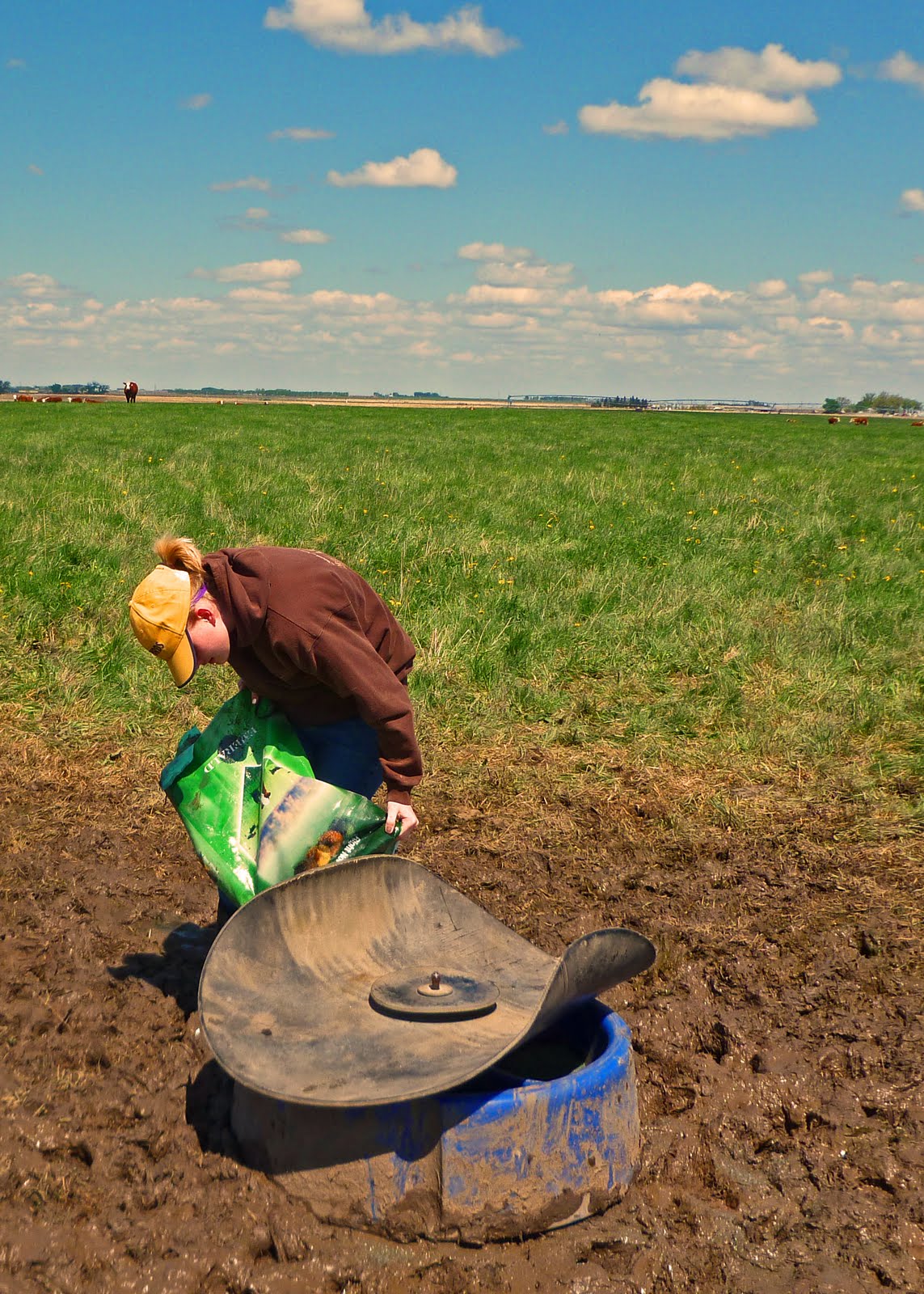
Refilling the mineral tubs. Mineral is a very important part of an animal's diet, especially in a wet season like this. Why? When the grass is growing this fast, it often doesn't get all the nutrients it needs from the soil- especially magnesium. A magnesium deficiency is very serious in cattle, as it leads to a disease called Grass Tetany. The mineral that we give to our cattle at this time of year is the Right Now Emerald mineral from Cargill Animal Nutrition. Emerald is specifically concocted for spring on pasture when cows will be calving and breeding, and contains the minerals they would likely be deficient of. The blue tub you see below is covered with a rubber flap that cows can stick their noses under. The flap prevents it from getting rained on or spilled.

I'd say life is pretty good for these critters, wouldn't you?